 |
| |
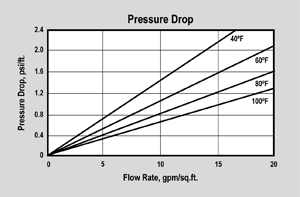
| PRESSURE DROP — The graph above shows the expected pressure loss per foot of bed depth as a function of flow rate at various temperatures. |
| |
 |
| |
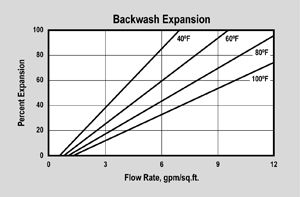
| BACKWASH — The graph above shows the expansion characteristics as a function of flow rate at various temperatures. |
| |
| |
| APPLICATIONS: |
Softening
ProSoft Gold is a standard crosslinked cation resin optimized for residential and commercial applications. This type of resin is easier to regenerate than the higher crosslinked resins. ProSoft Gold has marginal resistance to chlorine and other oxidants and is not ideal for high temperature and other high stress applications. |
| |
 |
| |
 |
| |
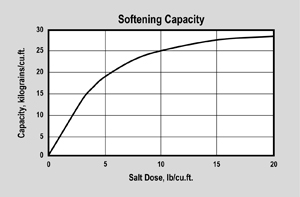
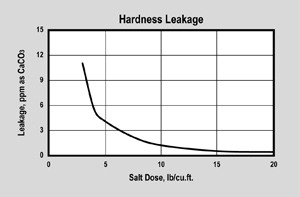
| CAPACITY AND LEAKAGE — Capacity and leakage data are based on 2:1 Ca:Mg ratio, 500 ppm TDS as CaCO3, 0.2% hardness in the salt, and 10% brine concentration applied co-currently through the resin over 30 minutes. No engineering downgrade has been applied. |
| |
| |
| ProSoft™ is a trademark of Safe Water Technologies, Inc. |
|
|
| |
Features: |
|
| |
• |
Optimized for residential softener applications |
|
| |
• |
Uniform particle size, low pressure drop |
|
| |
• |
Superior physical stability |
|
| |
• |
Low color throw |
|
| |
• |
Conforms to paragraph 21CFR173.25 of the Food Additives Regulations of the US FDA |
|
| |
• |
Certified to NSF/ANSI Standard 44/61 * |
|
|
| |
| PART NUMBER |
| Sodium Form |
ER10001 |
|
| |
| PHYSICAL PROPERTIES |
| Polymer Structure |
Styrene/DVB |
| Polymer Type |
Gel |
| Functional Group |
Sulfonic Acid |
| Physical Form |
Spherical beads |
| Resin Color |
Amber |
| Ionic Form (as shipped) |
Sodium |
| Total Capacity |
> 1.8 meq/mL |
| Water Retention |
40 to 52% |
| Screen Size Distribution |
16 to 50 (US mesh) |
| Maximum Fines Content |
1% (< 50 mesh) |
| Minimum Sphericity |
90% |
| Uniformity Coefficient |
1.6 approx. |
| Approx. Ship. Wt. |
50 lb/cu.ft. |
|
| |
| SUGGESTED OPERATING CONDITIONS |
| Maximum Temperature |
250°F (121°C) |
| Minimum Bed Depth |
24 inches |
| Backwash Expansion |
25 to 50% |
| Maximum Pressure Loss |
25 psi |
| Operating pH Range |
0 to 14 |
Regenerant Concentration
Salt Cycle |
10 to 15% NaCl |
| Regenerant Level |
4 to 15 lb/cu.ft. |
| Regenerant Flow Rate |
0.5 to 1.5 gpm/cu.ft. |
| Regenerant Contact Time |
> 20 minutes |
| Displacement Flow Rate |
Same as dilution water |
| Displacement Volume |
10 to 15 gal/cu.ft. |
| Rinse Flow Rate |
Same as service flow |
| Rinse Volume |
35 to 60 gal/cu.ft. |
| Service Flow Rate |
1 to 10 gpm/cu.ft. |
|
| |
| |
|
CAUTION: DO NOT MIX ION EXCHANGE RESINS WITH STRONG OXIDIZING AGENTS. Nitric acid and other strong oxidizing agents can cause explosive reactions when mixed with organic materials such as ion exchange resins.
|
| |
ADDITIONAL INFORMATION:
SWT Ion Exchange Resin Guide
Cation Resin Selection Chart
Resin Capacity Comparison Chart
Iron Removal Comparison Chart
|
| |
| |
|
This information has been gathered from standard materials and or test data that is believed to be accurate and reliable. Nothing herein shall be determined to be a warranty or representation expressed or implied with respect to the use of such information or the use of the goods described for any particular purpose alone or in combination with other goods or processes, or that their use does not conflict with existing patent rights. No license is granted to practice any patented invention. It is solely for your consideration, investigation and verification.
|
|
