|
|
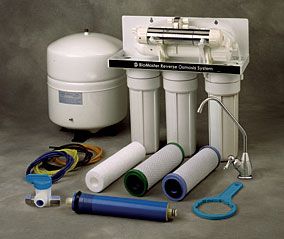
| SWT’s BioMaster™ Reverse Osmosis System (P/N RO43802-50)
provides quality RO filtered water as well as bacteria and virus sterilization for the most complete, affordable, high purity drinking
water treatment available to the homeowner. For pennies a day, the BioMaster™ will deliver better than bottled water quality. |
| |
 |
| |
|
A maintained BioMaster™ Drinking Water System means you will never have to worry again about the quality of
your water supply. |
|
Each unit includes all hardware necessary for installation. |
ADDITIONAL INFORMATION:
SWT Residential RO Systems Guide |
|
| FEATURES INCLUDE: |
| • |
Sediment filtration to remove particulate matter (grit, sand, sludge, silt, etc).
|
| • |
A special heavy metal pre-filter cartridge designed to extend the life of the
RO membrane (a unique SWT design feature).
|
| • |
Heavy metal filtration (lead, iron, zinc, etc).
|
| • |
Pre- and post-carbon filtration for the removal of chlorine, taste, odor, color, pesticides,
and a whole list of chemical compounds deemed unhealthy by the EPA ( see list below).
|
| • |
A reverse osmosis membrane for ultra-fine (molecular) filtration. Primary agents filtered are sodium,
nitrates, lead, fluoride, cryptosporidium, cysts, iron, copper, mercury, and arsenic. The RO element
in the BioMaster™ will remove 93% to 99+% of these and other compounds
( see list below).
|
| • |
An ultraviolet disinfecting chamber that sterilizes viruses, bacteria, mold, algae, and other harmful
microorganism ( see list below).
|
|
|
| |
| |
|
SWT BIOMASTER™ RO SYSTEM PERFORMANCE SPECIFICATIONS |
With proper installation and maintenance the RO membrane
module in the SWT BioMaster™ Reverse Osmosis System will reject the following substances from tap water:
Arsenic
Barium
Bicarbonate
Boron
Bromide
Cadmium
Calcium
Chloride
Copper
Cyanide
Flouride
Hardness
Iron
Lead
Magnesium
Manganese
Mercury
Nickel
Nitrate
Phosphate
Potassium
Pyrogen
Selenium
Silica
Silicate
Silver
Sodium
Strontium
Sulfate
Zinc |
94-96%
96-98%
95-96%
60-70%
93-96%
96-98%
94-97%
87-95%
98-99%
86-95%
94-96%
95-98%
95-98%
96-98%
96-98%
98-99%
96-98%
98-99%
90-96%
96-99%
87-97%
98-99%
96-98%
85-90%
95-97%
95-97%
87-98%
96-98%
98-99%
98-99% |
...plus more.
The RO membrane module will also aid in the removal of color, asbestos, and cysts such as giardia and
cryptosporidium.
Contact your SWT representative for more details.
|
|
|
The SWT BioMaster™ is much more than an RO system. It has been designed to work on water that has
chemical and bacterial contamination also. The carbon filtration modules will remove, or significantly
reduce, over 50 chemical substances that the EPA has deemed potential carcinogens. They include:
|
Adipates (diethylhexyl)
Alachor
Aldicarb
Aldicarb sulfone
Aldicarb sulfoxide
Atrazine
Benz (a) anthracine (PAH)
Benzene
Benzo (a) pyrene (PAH)
Benzo (b) floranthene (PAH)
Benzo (k) floranthene (PAH)
Beryllium
Butyl benzyl phthalate (PAE)
Cadmium
Carbofuran
Carbon tetrachloride
Chlordane
Chlorine
Chromium (+3)
Chrysene
Dalapon
Di (2-ethylhexl) adipate
Dibenz (a,h) antracene
Dibromochloropropane |
Dichlorobenzene (meta-)
Dichlorobenzene (ortho)
Dichlorobenzene (para-)
Dichloroethane (1,2-)
Dichloroethylene (1,1-)
Dichloroethylene (cis-1,2-)
Dichloroethylene (trans-1,2)
Dichloropropane
Diethylhexyl phthalate (PAE)
Dinoseb
Diquat
Endothall
Endrin
Ethylbenzene
Ethylene dibromide (EDB)
Glyphosate
Heptachlor
Heptachlor epoxide
Hexachlorobenzene
Hexachlorocyclopentadiene
Indo (1,2,3-c,d) pyrene (PAH)
Lidane
Mercury (organic complexes)
Methoxychlor |
Monochlorobenzene
Organic color
Organics
Oxymal
Pentachlorophenal
Picloram
PCB’s
Simazine
Styrene
3,7,8-TCDD (dioxin)
2,4-D
2,4,5-TP (silvex)
TCB’s
TCE’s
Tetrachloroethylene
Thallium
THM’s
Toulene
Toxaphane
Vinyl chloride
Xylenes |
|
| |
| |
|
After the water has been filtered down to a sub-micron level, the
water then enters an ultraviolet sterilization chamber where any viruses, bacteria, mold,
and other living microorganisms are bombarded with special, intense light of a specific
wavelength. The UV light penetrates the wall of the organisms and attacks their DNA
structure leaving the organism unable to reproduce (or “dead”). UV technology
is recognized by the EPA as one of four approved methods of sterilizing water, and is
preferable over the other three methods (chlorine, iodine, and distillation) due to the
cost of treatment and effectiveness of UV (UV works almost instantaneously, leaving no
residuals or chemicals in the water). The SWT BioMaster™ UV module operates for a
full year at 30,000 microwatt seconds/cm². As a point of reference, the table below
is a list of common bacteria and viruses, and the dosage required to render them harmless.
|
BACTERIA
Bacillus anthacis
B. Megaatherium sp. (veg.)
B. Megaatherium sp. (spores)
B. paratyphosus
B. subtilis
B. subtilis spores
Clostridium tetani
Corynebacterium diphtheria
Dysentery baccili
Eberthella typhosa
Escherichia coli
Leptospira
Micrococcus candidus
Micrococcus sphaeroides
Mycobacterium tuberculosis
Neisseria catarrhalis
Phytomonas tumefaciens
Proteus vulgaris
Pseudomonas aeruginosa
Pseudomonas fluorescens
Salmonella
S. enteritidis
S. typhimurium
S. typhosa
Sarcina lutea
Serratia marcescens
Shigella dysenteriae
Shigella paradysenteriae
Spirillum rubrum
Staphylococcus albus
Staphylococcus aureus
Streptococcus hemolyticus
Streptococcus viridans
Vibrio cholerae |
8,700
2,500
5,200
6,100
11,000
22,000
22,000
6,500
4,200
4,100
6,600
6,000
12,300
15,400
10,000
8,500
8,500
6,600
10,500
6,600
10,000
7,600
15,200
4,100
26,400
6,160
4,200
3,400
6,160
5,720
6,600
5,500
3,800
6,500 |
|
MOLD SPORES
Mucor racemosus A
Mucor racemosus B
Oospora lactis
Penicillium expansum
PROTOZOA
Chlorella vulgaris (algae)
VIRUSES
Bacteriophage (E. coli)
Hepatitus virus
Influenza virus
Polio virus
YEAST
Baker’s yeast
Brewer’s yeast
Common yeast cake
Saccharomyces cerevisiae
Saccharomyces ellipsoideus
Saccharomyces sp. |
35,200
35,200
11,000
22,000
22,000
6,600
8,000
6,600
6,000
8,800
6,600
13,200
13,200
13,200
17,600 |
|
|
|
| |
| |
|
GENERAL INSTALLATION AND SERVICE PARAMETERS |
SWT’s BioMaster™ will work at peak efficiency on either municipal or ground
water supplies that do not exceed the following:
Maximum psi
TDS
Iron
Hardness
Hydrogen Sulfide
Manganese |
125 lbs.
1800 ppm
0.4 ppm
17 gr/gal
0.05 ppm
0.1 ppm |
|
|
The SWT BioMaster™ RO System has been designed to give many years of trouble
free service. To keep the system operating in peak efficiency, it is recommended that the unit be inspected
every six months for possible prefilter sediment clogging (especially if there is a lot of sediment in the
water supply). The manufacturer recommends that the system be serviced on an annual basis to replace the
carbon filtration modules and the RO membrane module.*
* The RO membrane module may last for a much longer period of time on relatively good
water. Check with your Water Treatment Professional for local water characteristics and testing.
|
|
| |
|
